In 2002 I "met" (on the Internet) the retired Manager of Collections of Smithsonian's Freer Gallery. The Freer-- and its neighbor, the Sackler-- have the premier collection of ancient jades in the U.S. He arranged for me-- through the current MC-- a private "basement tour" of the Sackler's jades. What a trip!
We began by going through a huge, thick, securely locked door downstairs that led to the Sackler's vault. Such treasures are inside! Cabinet after cabinet filled with superb ancient bronzes, Neolithic ceramics, archaic jades, you name it! Each modern metal cabinet has glass-windowed doors up top, where the larger items are kept, and maybe a dozen "flat file" drawers beneath. Maybe 15-20 cabinets in all. Each drawer, maybe 6 feet wide, contained 12-30 jades, all resting on chemically neutral foam padding.
Mostly we looked at jades from the Dr. Paul Singer collection. These had recently been donated and were in the process of being cataloged. There were also Sackler jades and some from Freer himself. I was allowed to pick them up and study them closely. Such magnificent pieces! Many of the most impressive ones were the tiniest-- some only 1/2" wide, from the Shang through Warring States periods. It reconfirmed my feeling that Warring States jades are among the finest ever produced.
It was intoxicating! And also the perfect antidote and chance for "recalibrating" after seeing the endless parade of preposterous fakes on eBay, etc. Nothing beats seeing and-- better!-- handling the real McCoy!
All of this was accompanied by rapid-fire descriptions from the MC, seasoned with fascinating stories about the collectors and curators. I learned that the Freer-Sackler is engaged in a massive book project to document all their jades. Former curator Dr. Jenny So (who kindly did several evaluations for me) is heading this up, commuting from Hong Kong where she now heads the Art Dept, I think he said, at HK University.
Among other things, I learned that many (162 or more) major bronzes and jades were missing from Dr. Singer's apartment after he died and bequeathed his collection to the Smithsonian. The suspicion is that they were stolen by visitors, relatives, and care-givers in his final years. I was handed a brochure picturing many of them, all "museum quality." I shook up the MC (for about half a second) by saying, "Hey, I've got three of these in my collection -!" Others are listed here.
I brought along one possibly Neolithic jade for evaluation, and the MC agreed it certainly appeared to be quite old. But that was not really the purpose of the visit.
As the 1-1/2 hour visit came to a close, the MC began opening drawers at an accelerated pace. "I just have another 1000 jades I'd like to show you!" he joked. He closed with his pieces de resistance, as he put it. First was an absolutely magnificent Western Zhou bronze short sword, in a custom fitted brocade box with jade scabbard chape and original silk cord still wrapped around the handle. A superb piece (Singer collection) and in wonderful condition. Then came a famous jade figure riding a Bixie, which I was quite familiar with from having seen it countless times when it was upstairs on exhibit. Ironically, I had once offered a nephrite copy of this piece on eBay, didn't get a single bid! OK, the original's maybe just a bit nicer than my copy! Finally came the MC's personal favorite: a jade bear from early Han or maybe a bit earlier. White jade streaked with black, it seemed to combine a bear's body, lion's mane, and what looked to me like a tapir's face.
I lost count of how many jades we saw. More than 500 probably, but maybe less than 1000. It would take a full month to see them properly. But what an exciting visit! My friend (now deceased, unfortunately) later arranged a similar basement tour of the Freer jades, which are under the care of a different person.
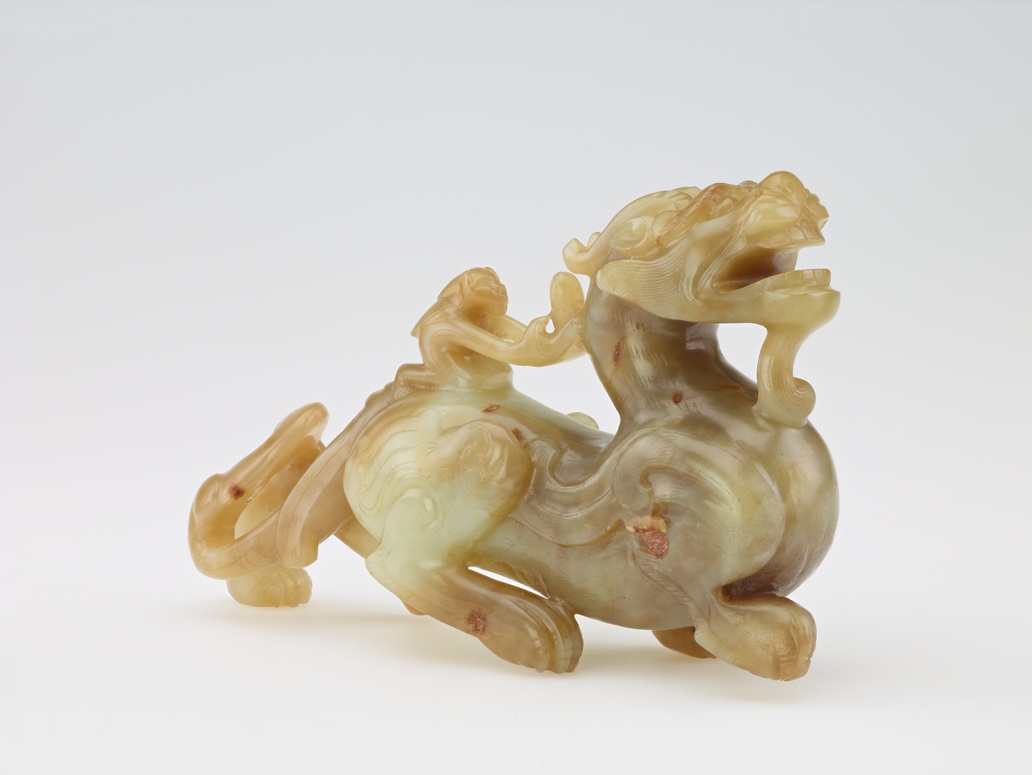
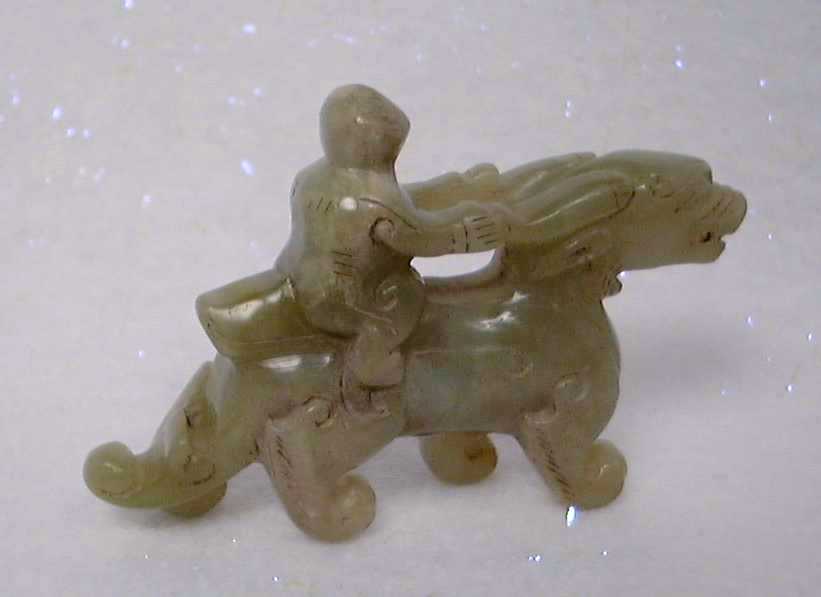
Sackler (20th C. forgery in Han style, left) and modern reproduction (right) Han Jade Bixie with Rider
(Originally unpublished, e-mail distribution)